The Order Inbox Is B2B's Biggest Untapped Channel
Why Aligent Has Partnered with Portalink
Let's get this out of the way: we love eCommerce. We've spent 17 years building it, we'll happily talk about it at a barbecue, and we've watched many of our customers grow online well above industry norms. So it's slightly awkward to admit that across the wider B2B ecosystem, eCommerce still accounts for less than 20% of orders.
The biggest B2B channel isn't your website
Some of our customers are pushing close to 90% of orders online. For most, though, there's still plenty of blue ocean. Around 70% of business orders are still exchanged through email, PDFs, spreadsheets and other disconnected channels.
That isn't a failure of digital strategy. It's how the majority of B2B buying needs to work. A procurement officer raises a PO in their own system and emails it across. A long-standing trade customer sends the same Excel template they've used for a decade. A national account's ERP generates a PDF in its own format, with its own product codes and its own units of measure.
Plenty of these customers will move to online eventually with the right portal, pricing and experience. Some never will, and for your largest accounts you probably wouldn't want to force the issue. So while the industry talks about online conversion, the order inbox quietly remains the highest volume sales channel for many manufacturers, distributors and wholesalers. It's also usually the least automated.
That's why we don't see eCommerce and offline ordering as separate problems. They're two channels into the same ERP, serving the same customers, often on the same day. Grow online whenever customers are ready, and automate everything that still arrives by email: capture it accurately, validate it against your business rules, and flow it into the ERP immediately without anyone touching it. Online gets faster, offline gets turned on, and the whole customer base benefits.
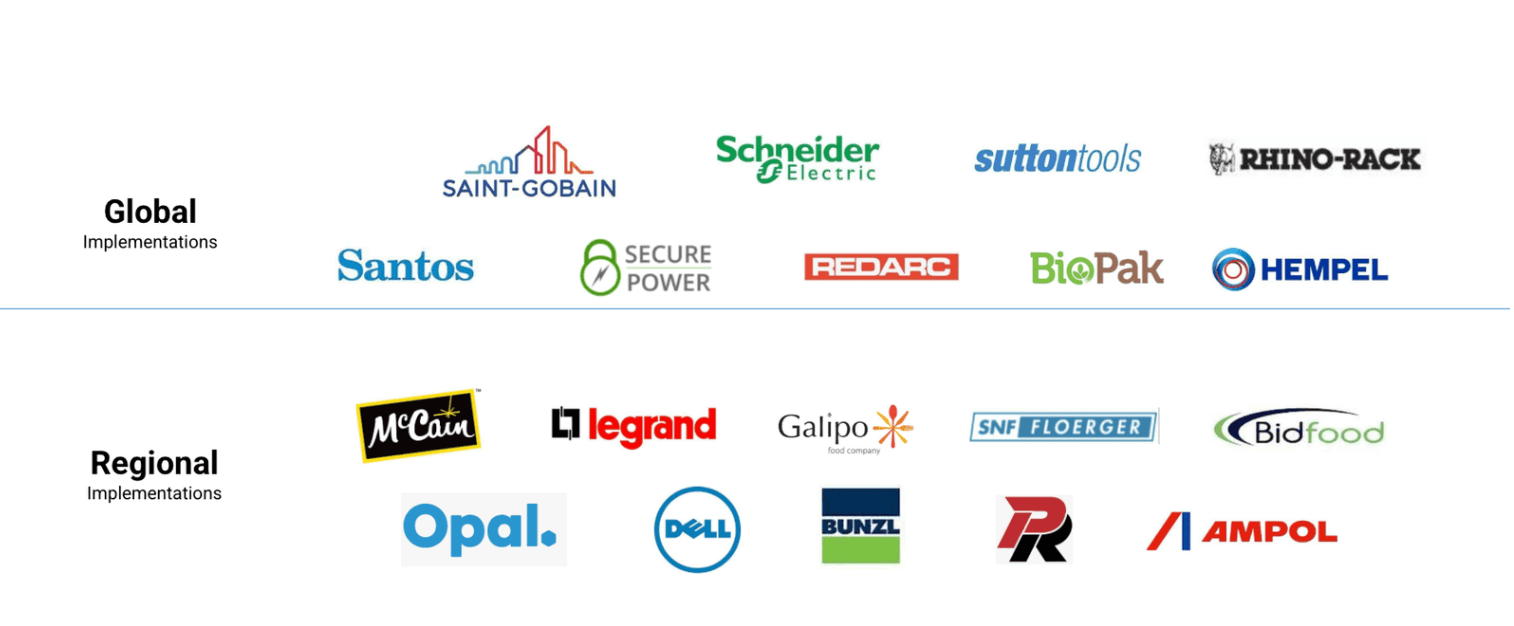
Brands that have successfully implemented Portalink
The hidden cost of rekeying orders
EDI was meant to solve this more than 50 years ago. In practice, EDI only ever made sense for the biggest trading partners. It's too expensive and too slow to onboard for the long tail of customers who make up most of the order count.
Everyone else gets processed by hand, and the cost shows up in predictable places:
Slower dispatch. Orders sit in a shared inbox until someone gets to them during business hours, and every hour in the queue is an hour off the delivery promise.
Errors that derail. A wrong product code, quantity or price becomes a wrong pick, a credit note, a return and an unhappy customer.
SLA penalties. For customers with service agreements, those late or incorrect orders cost real money, not just goodwill.
Retention risk. Winning a customer can take months or years. Losing one can take a single botched order.
A capacity ceiling. Growing order volume requires growing headcount, and skilled customer service staff spend their day on data entry instead of account management, upselling and cross-selling.
It all translates into increased cost to serve. An independent study of 100 Fortune 500 companies by Lora Cecere of Supply Chain Insights puts the average cost of a manually processed order at around US$75 (source: https://portalink.com/anyorder )
The gap also widens with growth. Manual entry costs scale with every extra order, while the cost of automation stays relatively flat.
The reason this has stayed unsolved isn't a lack of software. B2B trading relationships are complex. Product codes vary between buyer and supplier, pricing changes, systems fall out of sync, and every customer relationship carries its own rules. That complexity is exactly where most automation approaches fall over.
Why this isn't OCR
When most people hear "PO automation", they picture OCR: software that scans a document, recognises the characters and tries to pull out the order details. It's the engine behind most document automation tools, including many of the newer AI-branded ones. It's also the reason so many of those projects stall.
OCR works from a picture of the document and makes its best guess at each character. That guess is usually right, but "usually" is the problem:
A 0 becomes an O, a 1 becomes an l, or a decimal point disappears from a quantity.
A table that wraps across two pages loses a line, or merges two.
A customer tweaks their template and the extraction quietly breaks.
In order processing, mostly right is wrong. An order with 39 correct lines and one bad one is a failed order. If you can't trust the capture, someone has to check every order against the original, which is the manual step you were trying to remove in the first place. You end up with the cost of automation plus the cost of manual review.
That's why trust is the real test. Automation only delivers zero-touch processing when the business can trust the data moving between systems. AI has a big role to play, but on its own it isn't the answer. It needs to work alongside proven processes, validation rules and human oversight.
Portalink takes a different approach. Rather than relying on a single scanning method, it automatically applies the most effective data capture method to each document, and each customer's order template is mapped so their orders are captured the same way every time. Portalink positions this as 100% accurate data capture, which is what makes genuinely touchless orders possible.
One of Portalink's global customers, Schneider Electric, put it simply: you cannot achieve zero-touch with OCR.
How Portalink AnyOrder works
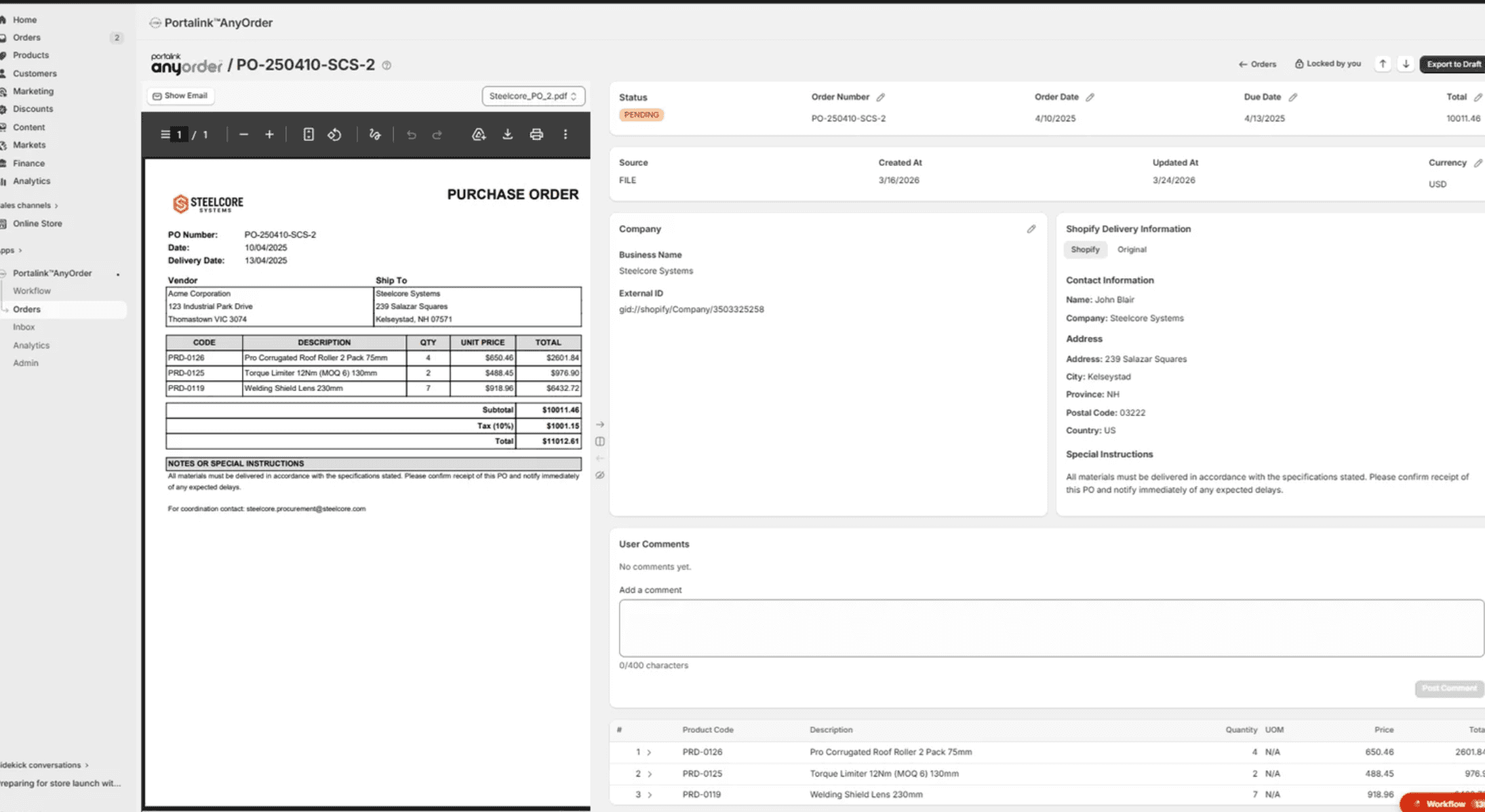
AnyOrder processes any order from any sender, whether it arrives as a PDF, an Excel file, an HTML email or EDI, through a single processing point. Your customer service team works in one system instead of juggling a different workflow for every order type.
Mapping. Portalink's AI-assisted, fully supported mapping service maps each customer's order template. Because mapping is fast and low cost, it's viable to automate every customer, from the largest account to the smallest, not just the top 20.
Validation. Integration with the ERP validates customer, product, pricing and business rules before the order lands. Errors are fixed before they reach the ERP, not after.
Exceptions. When a genuine data issue comes up, such as an unknown product code, it's flagged to the team for a quick decision.
Continuous improvement. Machine learning learns from those decisions, so the zero-touch rate climbs over time.
Portalink calls the end state "True-Touchless": orders that arrive ready for pick and pack, with no second touch in the ERP. The published outcomes are hard to ignore: 80%+ of orders processed touchless within the first 12 months, 85% less manual entry, 85% faster from inbox to pick slip and a 60% reduction in SLA penalties.
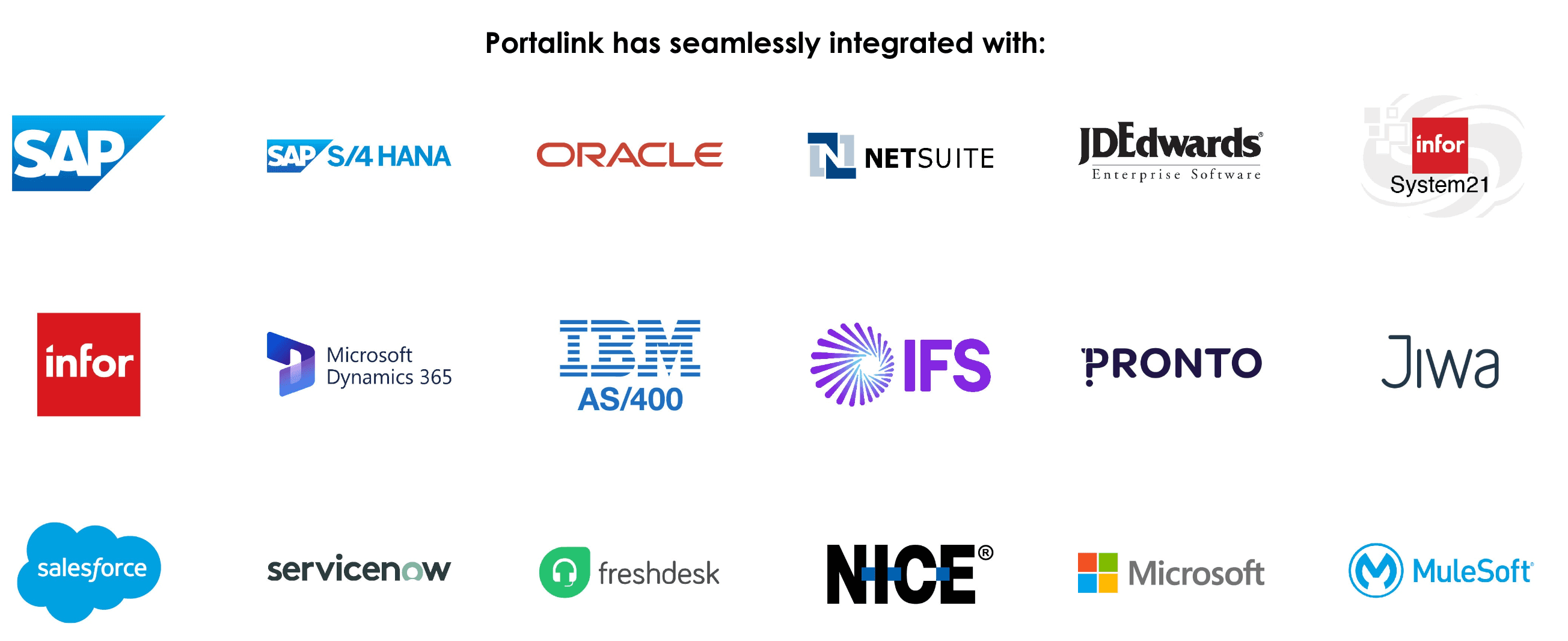
Importantly, AnyOrder isn't tied to a particular commerce platform. It sits between the inbox and the ERP, so it works alongside whatever eCommerce platform, portal or ERP a business already runs.
Why Aligent is partnering with Portalink
Aligent has spent 17 years helping B2B businesses sell more efficiently. That work has centred on four things: eCommerce, integration, product data and order management. We build the storefronts and trade portals, clean up and govern the product information behind them, and connect orders through to the ERP, CRM and warehouse.
Automating offline ordering was the obvious next step. For most of the manufacturers, distributors and wholesalers we work with, emailed orders still represent a significant share of total volume, and a significant share of cost to serve. It's the part of the order-to-cash process where there's the most manual effort left to remove.
It also completes the picture. A trade portal serves the customers who want to self-serve or discover your range. AnyOrder serves the customers who will keep sending a PO, and there will always be some. Put together, every order, however it arrives, flows into the same ERP with the same business rules applied. That's what omnichannel actually looks like in B2B: not forcing customers into one channel, but connecting all of them.
And like Aligent, Portalink is platform agnostic.
Proven at global scale, and right-sized for local businesses
Before partnering with anyone, we wanted to see runs on the board. Portalink has them at both ends of the market.
At the global end, Portalink works with complex organisations like Schneider Electric, processing orders across regions, divisions and thousands of customers. Independent technologists in Boston have assessed Portalink as unrivalled for zero-touch order entry in complex business environments. Schneider's Global Director of Innovation, Mark Minnucci, summed up why it holds up at that scale: "Portalink is the only system that becomes more cost effective with scale."
Closer to home, Portalink supports ANZ operations like Legrand, and Australia-only businesses that don't have global IT teams behind them. Legrand's Group IT Manager ANZ described the value as every order, wherever it comes from, having the same business rules applied and flowing through to the ERP automatically.
That range mattered to us. Our clients include national businesses expanding across divisions and brands, and local businesses whose entire order book comes through one shared inbox. We needed a solution that could scale across countries and divisions for the former, without being oversized or overpriced for the latter.
Where to start
The business case for AnyOrder usually starts in the inbox. A few questions tell you most of what you need to know:
How many orders arrive by email each month, and what share of total volume is that?
How many different customer formats are you handling?
How many people touch an order before it's ready to pick?
What does an incorrect order cost you in credits, returns, penalties and staff time?
How many customer service staff do you manage?
If the answers are uncomfortable, you're not alone. For most B2B businesses, offline orders are the largest channel that hasn't been automated yet, and that makes them one of the biggest opportunities to reduce cost to serve.
If you'd like to understand what AnyOrder could do for your order volumes, get in touch with the Aligent team.